

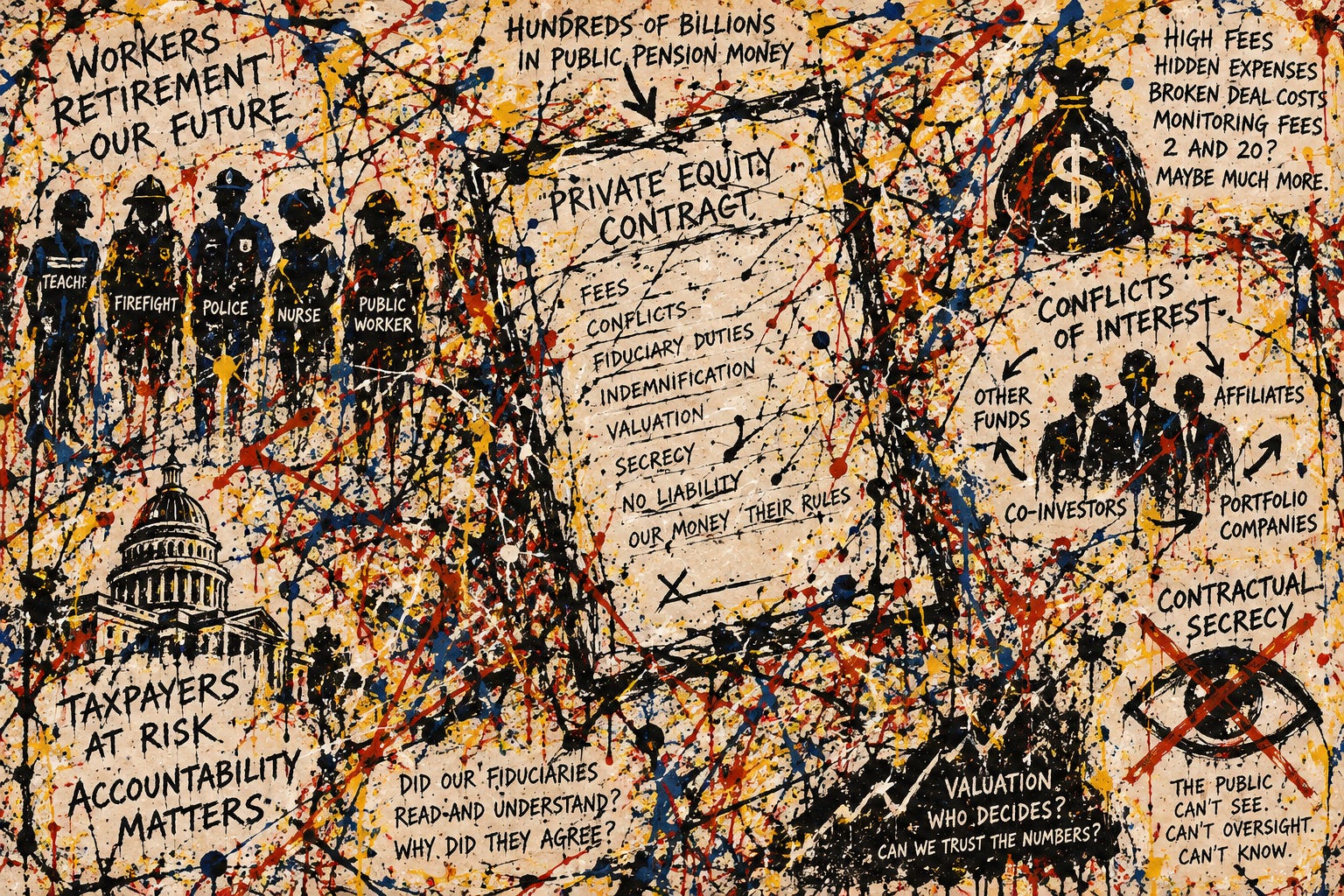
America’s state and local pension funds have committed hundreds of billions of dollars of workers’ retirement savings to private equity and other private-market investments. Yet the contracts governing many of these investments—Limited Partnership Agreements, Private Placement Memoranda, subscription agreements and side letters—are generally not available for meaningful public scrutiny. That creates an extraordinary accountability problem.
A teacher, firefighter, police officer or other government worker may be told that private equity is an important component of his or her retirement portfolio. Taxpayers may ultimately be responsible for making up pension funding shortfalls.
But neither group can ordinarily answer some remarkably basic questions:
What exactly did the pension agree to? What fees can the manager charge? What conflicts did the pension consent to? What fiduciary protections were waived or weakened? Can expenses benefiting other investors be charged to the pension? Can the manager transact with its own affiliates? Can some investors secretly receive better rights than others? Who determines the value of investments that have no observable market price? And who at the pension actually read, understood, negotiated and approved these provisions?
These are not mere theoretical concerns. The SEC’s enforcement history shows that fees, expenses, valuation practices and conflicts of interest in private equity have repeatedly created serious investor-protection problems. The Institutional Limited Partners Association—whose members include supposedly sophisticated institutional investors—has itself urged Limited Partners to reject certain contractual provisions that weaken fiduciary duties and permit overly broad conflicts.
The public therefore has good reason to ask a simple question:
If public pension fiduciaries are investing public retirement assets under contracts the public cannot inspect, how can workers and taxpayers determine whether those fiduciaries are prudently protecting their money?
The Contract Matters More Than The Investment
Most discussions about private equity focus on investment performance. Did the fund earn 15 percent? Did it outperform public equities? What was its IRR?
But before asking whether an investment performed well, pension participants should ask what their pension agreed to when it invested.
Private equity is fundamentally contractual. The Limited Partnership Agreement and related documents can determine who pays expenses, who controls valuation, how conflicts are handled, what information investors receive, what remedies investors possess and how much discretion the general partner enjoys.
ILPA has gone so far as to publish model LPAs because, in its words, investors need “fair and transparent terms” explaining their rights and obligations.
And ILPA’s Principles 3.0 contain an extraordinary warning for institutional investors: Limited Partners should reject provisions allowing a General Partner to reduce fiduciary duties to the fullest extent permitted by law, as well as waivers covering broad categories of conflicts. ILPA even cautions that fiduciary disclaimers may appear in unexpected sections of an LPA—or in documents other than the LPA itself.
Think about what this warning means. The investment industry representing sophisticated limited partners considers these contractual provisions sufficiently concerning that it specifically warns investors to look for—and reject—them.
What happens when the investor is a public pension investing workers’ retirement money and taxpayers cannot see the contract?
Contractual Reduction of the Manager’s Fiduciary Duties
Among the most consequential provisions in private fund documents are those seeking to limit the duties the general partner owes investors. The documents can contain elaborate provisions defining the General Partner’s standard of care, limiting liability, granting broad discretion and specifying circumstances under which conflicts are considered authorized.
ILPA’s position is striking: partnership agreements should reinforce rather than dilute General Partner’s fiduciary duties. It recommends that Limited Partners reject provisions allowing the GP to reduce fiduciary duties “to the fullest extent allowable by law.”
That raises an obvious question for public pensions. Has your pension agreed to any such provision? Workers probably don’t know. Taxpayers probably don’t know. And because the contract may be confidential, they may have no practical means of finding out. Does state pension staff even know whether they agreed to such an abusive provision? Don’t count on it.
Broad Advance Consent to Conflicts of Interest
Imagine giving someone hundreds of millions of dollars to manage and simultaneously agreeing in advance that the manager may encounter numerous conflicts involving itself, its affiliates, other funds, co-investors and portfolio companies.
Private-market organizations often manage multiple funds, separate accounts, continuation vehicles and co-investment programs while conducting other businesses. That creates unavoidable conflicts over who gets which investment, who bears which expense, which vehicle buys or sells an asset and at what price.
ILPA says that merely disclosing conflicts in offering documents should not automatically make the conduct permissible or eliminate the need for appropriate Limited Partner Advisory Committee approval. In short, disclosure of a conflict is not the same thing as eliminating the conflict.
Nor does inserting 20 pages of potential conflicts into a 500-page document necessarily establish that a pension fiduciary thoughtfully determined that every conflict was acceptable.
“Sole” Discretion Provisions
Another red flag is language giving the manager “sole,” “absolute” or similarly broad discretion over matters affecting investors. These powers may concern allocation of investments, expenses, valuations, reserves, distributions, conflicts or other economically significant decisions. Again, ILPA warns investors about excessive discretion. It says sole-discretion provisions should be acceptable only where the Limited Partner has sufficient comfort that investors will not be adversely affected. Translation: NEVER.
For a public pension, the question should therefore be: Precisely what discretion did our fiduciaries surrender to the manager, and why did they determine surrendering it was prudent?
Charging Your Fund For Expenses That Benefit Others
Again, the concern here is not hypothetical. The SEC has charged managers in the past with misallocating more than millions in “broken-deal” expenses to flagship private-equity funds. Co-investors benefited from deal sourcing but did not bear their proportionate share of those expenses. The SEC has described broader concerns involving private-equity managers shifting expenses from management companies onto funds and allocating expenses among funds, co-investment vehicles and preferred investors. This presents a simple fiduciary question:
Why should public workers’ retirement money pay expenses properly attributable to somebody else?
And an equally important transparency question:
How would participants ever know that their pension agreed to contractual language permitting it?
Broker Deal Expenses
Private equity funds routinely investigate acquisitions they ultimately abandon. Someone must pay the lawyers, accountants, consultants, bankers, travel expenses and other costs associated with those failed transactions. Often that someone is the fund.
Publicly available private-fund disclosures illustrate how expansive these provisions can become. Certain filings disclose that broken-deal expenses can encompass legal, accounting, tax and consulting expenses, financing costs, travel and entertainment, forfeited deposits and even litigation-related costs. Some disclosures contemplate circumstances in which one investment vehicle can bear more than its pro-rata share.
These provisions deserve particular scrutiny when parallel funds, separately managed accounts, employees or favored co-investors also potentially benefit from the investment opportunity.
Portfolio Company Fees and Other Charges
Management fees and carried interest aren’t the end of the compensation story. Private-equity managers and affiliates may receive monitoring fees, transaction fees, director fees, advisory fees and other compensation associated with portfolio companies.
The SEC has repeatedly focused on these arrangements. For pension beneficiaries, the relevant question isn’t merely: “What is the stated management fee?” It is: “What is every dollar of compensation, expense and economic benefit the manager and its affiliates can receive directly or indirectly as a consequence of managing our money?”
Those are very different questions—questions which no state pension in our experience is capable of answering. Ask public pension officials and, be assured, any answer you get will be incomplete. They don’t ask the money managers for a full accounting, hence they don’t know the full amounts.
Indemnification and Exculpation
Most private-fund agreements contain broad protections for the General Partner and its related parties. Indemnification provisions can require the fund—and therefore its investors—to bear costs associated with claims against the manager or affiliated persons, subject to whatever exceptions were negotiated.
Exculpation provisions can limit circumstances in which the manager may be held liable.
ILPA recommends that General Partner breaches involving matters such as gross negligence, fraud, willful misconduct or breach of the agreement be outside the protection of indemnification and exculpation provisions. It also recommends rejecting provisions allowing indemnification for material breaches of the partnership agreement, fiduciary breaches and other “for cause” events. That should lead every public pension participant to ask: Exactly how much legal protection did our pension negotiate for us—and what did it give away?
Side Letters: Are Some Investors Given Preferential Treatment?
The Limited Partnership Agreement may not even tell the entire story. Virtually all large investors negotiate separate agreements known as side letters. Those agreements can provide particular investors with special economic, informational, governance or other rights. Preferential treatment for some investors inevitably means others are harmed.
Preferential treatment for some investors inevitably means others are harmed.
The SEC was sufficiently concerned about preferential treatment that its 2023 private-fund rules would have imposed substantial disclosure requirements concerning preferential arrangements. The important public-pension question remains: Does another investor in the same fund have materially better rights than the state pension—and does the pension even know the full extent of those rights?
Participants cannot answer that question without access to meaningful information about side letters and preferential arrangements.
Conflicted Transactions Between Fund Controlled by the Manager
One of private equity’s most fundamental conflicts occurs when a manager effectively sits on both sides of a transaction. A manager might move an investment from one fund nearing the end of its life into another vehicle managed by the same organization.
Who wants the highest price? The selling fund.
Who wants the lowest price? The buying fund.
Who represents both? The same investment manager.
Continuation vehicles have made these issues increasingly important. A public pension should be able to explain exactly how it protects beneficiaries when its investment manager has conflicting economic incentives.
Valuation Discretion Over Assets With No Market Price
While public stocks have observable market prices, private companies generally do not. Their values therefore depend substantially upon models, assumptions, comparable companies, projected cash flows and other judgments. That matters because valuations can affect reported performance and, depending upon the fund structure, fees and carried interest.
SEC examination staff has found instances where private-fund advisers failed to follow disclosed valuation procedures and where inappropriate valuations resulted in investors being overcharged management fees or carried interest.
So pension participants deserve to know:
Who determines the value? What discretion does the manager possess? Who independently verifies the valuation? Does the pension have sufficient information to challenge it? Has the pension ever done so?
The Ultimate Question: Did Anyone at the Pension Actually Read All of This?
The documents governing a single private-equity investment can be lengthy, technical and distributed across multiple instruments. They include the Limited Partnership Agreement; Private Placement Memorandum; subscription agreement; side letters; amendments; advisory-committee provisions; valuation policies; fee and expense provisions; and subsequent notices and consents.
The critical oversight question therefore isn’t whether a pension employee received the documents. It is whether qualified fiduciaries read them, understood them, compared them with industry best practices, identified provisions adverse to beneficiaries, attempted to negotiate them and documented why accepting the remaining risks was prudent.
There is an enormous difference between possession of a document and informed fiduciary review of it.
“It Was Disclosed” Is Not An Adequate Answer
Private-equity managers sometimes respond to criticism by saying a particular practice was disclosed in the fund documents. That may appear to be legally significant. But from a public-pension governance perspective, it should be the beginning of the inquiry—not the end.
Suppose an offering document plainly says that the manager may engage in a transaction presenting a serious conflict of interest or even outright violation of law.
The manager may argue the pension agreed he could do it. The question for the pension fiduciary is: Why on earth why did you agree to it?
Disclosure to the investor doesn’t automatically establish prudence by the investor. And disclosure to pension investment staff is not the same as disclosure to the workers and taxpayers whose money is ultimately at risk.
Private Investment Secrecy Makes Fiduciary Accountability Damn Near Impossible
The central problem is that if the public cannot inspect the agreements, outsiders generally cannot independently determine whether a particular pension accepted unusually manager-friendly terms; waived or diluted protections; authorized potentially costly conflicts; agreed to excessive or poorly defined expenses; received inferior terms compared with other institutional investors; negotiated meaningful protections; complied with applicable fiduciary requirements when approving the investment; or adequately monitored whether the manager subsequently complied with the agreement.
This creates an extraordinary information asymmetry. The manager knows. The pension’s investment staff may or may not know. Outside consultants may or may not know. But the workers whose retirement security is at risk—and taxpayers potentially responsible for funding deficiencies—do not know.
We Already Know These Risks Are Real
No one needs to speculate about whether private-equity conflicts can harm investors. The SEC has brought enforcement actions involving expense allocation, accelerated monitoring fees, portfolio-company expenses and other conflicts. SEC officials have warned for years about conflicts involving expense shifting, co-investments, parallel vehicles and managers’ other businesses.
And ILPA—hardly an anti-private-equity organization—has developed extensive principles addressing fiduciary duties, conflicts, fees, expenses, governance, side letters and transparency precisely because these issues matter to sophisticated institutional investors.
So the question is no longer whether these risks exist. The question is whether public pension participants should be permitted to determine how their own pension fiduciaries have dealt with them.
“Confidential” Should Never mean “Beyond Accountability”
There arguably may be legitimate reasons not to disclose particular competitively sensitive information about portfolio companies or prospective transactions. That does not logically require blanket secrecy surrounding every economically significant provision of a pension’s private-market agreements.
Put the Burden Where It Belongs
Pension participants should not have to prove that a secret contract contains abusive provisions before being permitted to see meaningful information about it. That turns accountability upside down. The pension is the fiduciary. The assets belong to a retirement system established for workers and beneficiaries. Taxpayers ultimately stand behind many public pension promises.
When a pension commits hundreds of millions—or billions—of dollars under a contract that may last ten, twelve, fifteen years or longer, the fiduciaries approving that investment should be able to demonstrate that they understood precisely what they were signing.
Sensitive portfolio-company information—if any—could still be protected.
But fiduciary decision-making would no longer disappear behind a wall of “trade secrets” and confidentiality.
Sunlight Changes The Question
Private equity’s defenders often emphasize that public pensions are sophisticated institutional investors. If that is true, transparency should demonstrate it. Show participants the protections the pension negotiated. Show them which provisions pension officials rejected. Show them the conflicts investment staff identified. Show them the fee provisions they scrutinized. Show them how they compared the proposed agreement with ILPA best practices. Show them the concessions they obtained. And where the pension accepted a provision materially favoring the manager, explain why doing so was nevertheless prudent.
Without meaningful disclosure, the public is being asked to accept something remarkably close to: Trust us. We carefully reviewed the contract. You just aren’t allowed to see what we agreed to.
For fiduciaries managing the retirement security of millions of public workers and billions of taxpayer-backed pension dollars, that should not be enough. The issue is bigger than whether private equity is a good or bad investment.
It is whether public pension fiduciaries can demonstrate that they have exercised informed, independent and prudent oversight over investments deliberately structured to give managers broad discretion, substantial compensation and extensive contractual protections.
Workers and taxpayers cannot meaningfully evaluate that oversight if the most important evidence—the agreements themselves and a clear explanation of their material terms—remains hidden from them.
The public does not need access to every so-called portfolio-company trade secret.
It does need enough information to determine whether the people entrusted with public retirement money are protecting the public—or merely signing what Wall Street puts in front of them.