

Immediately following our 2024 forensic investigation exposing massive underreporting of investment fees at Minnesota’s State Board of Investment, the state pension quietly began ratcheting up the investment fees disclosed in its financial reports from $83 million to $670 million—a staggering 800% increase. The underreporting of billions in fees paid by the fund to Wall Street investment firms over the decades was blatant, as well as predictable—given national public pension lack of financial integrity and the politics impacting all these funds.
We predicted it in Minnesota. And the state pension massively changed its reported fee amounts, immediately by 400% and by another 400% percent a year later. No one in Minnesota media or government expressed alarm and no one was held accountable.
It seemingly didn’t matter that the state pension’s financial statements were wildly inaccurate.
We also noted in our investigative findings that Minnesota pensions remarkably claimed 0.2% outperformance for all five periods. The “miraculous” performance results amounted to, at a minimum, brazen benchmark bias.
When financial statements are so unreliable with respect to key elements, such as reported investment fees and performance, it’s debatable whether they have any value whatsoever. Why bother?
The financial shenanigans at Minnesota’s public pensions are hardly unique. As we noted in our bestselling book, Who Stole My Pension? all public pensions in America are prone to “massage” the financial results they report to the public. We call it “gross malpractice generally practiced.”
By way of background, immediately following our forensic of the Rhode Island pension in 2013, the state immediately increased its disclosed investment fees from $11 million to nearly $80 million—a 700% increase—rising to $188 million over time.
In 2015, following release of our findings of under-reporting of investment management fees at state pensions in Rhode Island and North Carolina and facing a wave of media criticism, the California Public Employees Retirement System (CalPERS) publicly acknowledged its fee disclosures had long been wildly understated. Reports in the New York Times and Fortune and CalPERS board workshop coverage highlighted that CalPERS had not been systematically tracking, i.e., did not actually know—indeed, supposedly “could not track”—the total carried interest it had paid to its private-equity managers.
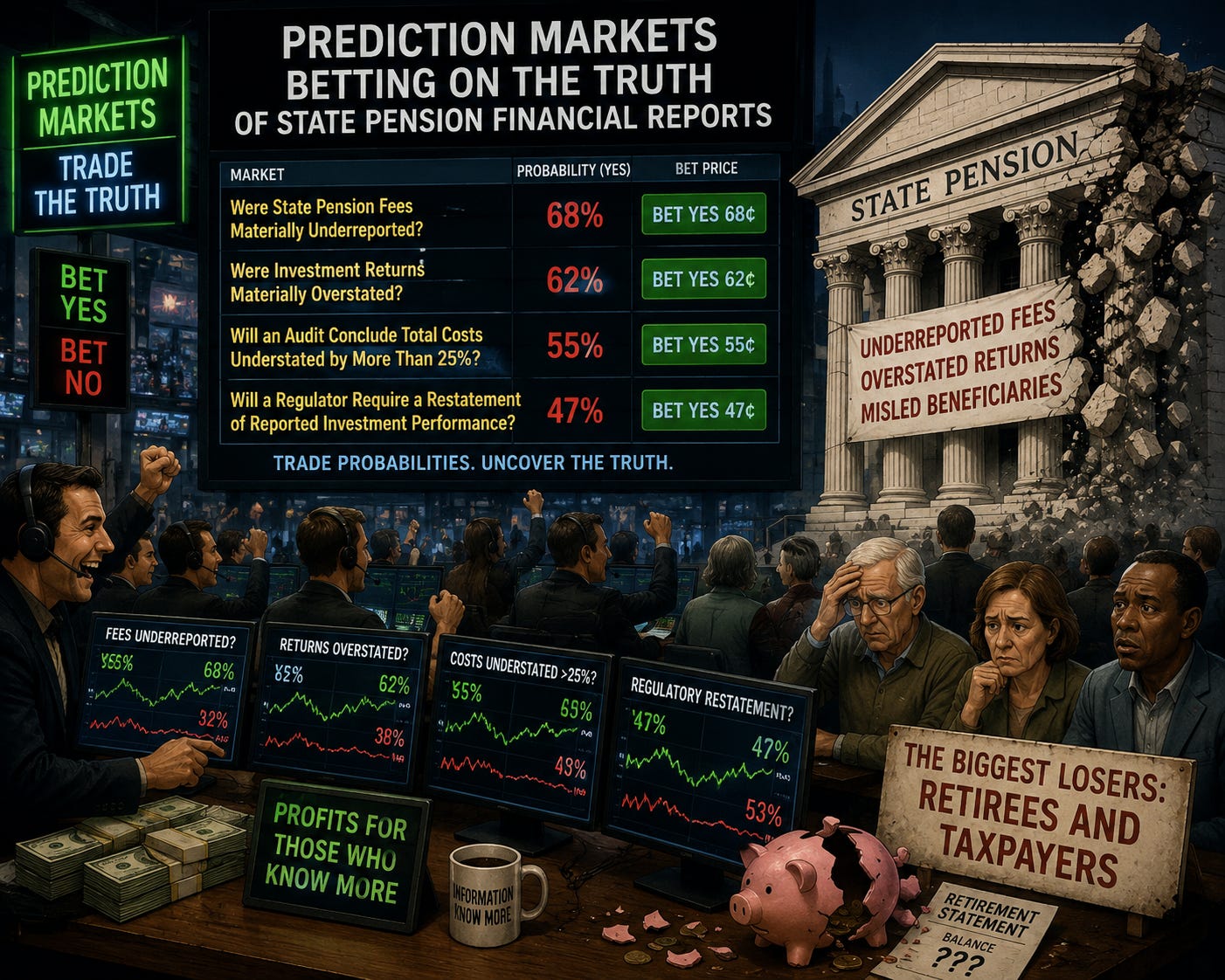
Could the prediction markets curb public pension financial reporting abuses?
Given the widespread blatant abuses involving nearly $7 trillion in our nation’s public pensions, what if it were possible to bet in the prediction markets that key financial information, such as state pension fees were underreported and investment returns were overstated? What would be the repercussions?
Could the prediction markets be used to combat obvious, widespread public pension financial misinformation involving trillions?
It appears that if prediction markets existed that allowed participants to bet on fundamental public pension financial reporting questions such as, were state pension X’s investment fees materially underreported; were state pension Y’s published investment returns materially overstated; will an independent audit conclude that disclosed investment costs understated total costs by more than 25%; will a regulator require a pension to restate its reported investment performance, the repercussions could be significant.
Continuous External Scrutiny
Most importantly, the potential effects include continuous external scrutiny. That is, instead of concerns surfacing years later through investigations—or rarer still— litigation, prediction markets could aggregate the views of analysts, actuaries, journalists, former employees, academics, and investment professionals. Large shifts in prediction market prices could act as a “red flag” that confidence in a given state pension’s reporting was deteriorating.
Pressure for greater transparency
If a prediction market consistently assigned a high probability to underreported fees or misstated returns, pension boards would likely face pressure from beneficiaries, taxpayers, legislators, auditors, and the media to disclose more information or commission independent reviews. Today, even when so-called “independent” reviews are commissioned by pensions, the results merely affirm the status quo. The prediction market could render bogus reviews lacking credible findings, worthless.
Lower public confidence
A prediction market implying, for example, a 70% probability that fees were materially understated could reduce public trust. This could impact confidence in pension governance.
Political consequences
Trustees, elected officials, and executives overseeing the state pension—all of whom typically lack investment training—could face increased scrutiny, particularly if market prices proved accurate after subsequent investigations.
Potential reduction in confidence, increase in borrowing costs
If concerns about governance spread broadly, investors might reassess risks associated with issuers connected to poorly governed pension systems. Any effect on state or local borrowing costs would likely depend on many factors beyond the prediction market itself.
Improved governance incentives
Knowing that independent participants were constantly evaluating disclosures could encourage more complete fee reporting, stronger internal controls, independent audits, improved documentation, and quicker correction of errors.
Is the prediction market risk greater than the status quo?
To be sure, there are also important risks. Prediction markets estimate probabilities based on participants’ beliefs and available information; they do not establish facts. Markets based on allegations of fraud or accounting misconduct could raise questions about market integrity.
Nevertheless, if prediction markets became sufficiently accurate over time, they might serve a role similar to bond market credit spreads, credit default swap prices, short interest in publicly traded companies, or auditor “going concern” warnings.
They would not replace forensic audits or regulatory investigations, but they could provide an independent, market-based indicator of perceived reporting risk.
The key distinction is that such markets would reflect collective expectations about future verification, not definitive findings. Any public or regulatory response would still need to rely on evidence established through audits, investigations, or other fact-finding processes.
Conclusion
Today, our nation’s public pensions, with nearly $7 trillion in assets under management, mislead investors globally about investment risks, fees and performance. The blatant under-reporting of investment fees and overstating of performance is provable through forensic investigations. Wall Street and local politicians benefit as pension stakeholders, including taxpayers and participants, pay the price and are kept in the dark. Our investigations have shown that, state pensions may radically restate their financial results—when publicly challenged. Greater scrutiny leads to quicker correction of errors.
Given the enormity of the problem, an approach that results in continuous public scrutiny of state pension financials may be worth trying.