

In America, 401(k) plans have become the dominant workplace retirement savings vehicle, with approximately $9.9 trillion in assets. Approximately 40-45 percent of all workers contribute to a 401k to some degree—which means the majority of Americans do not.
Let that fact soak in: The majority of Americans do not have any retirement savings whatsoever.
You will often see articles and tables discussing “average” 401k balances by age. These article focus only upon: (1) Those Americans who have 401k accounts; and (2) Provide “averages,” which are significantly higher than “medians” because a small number of really large accounts pulls the average significantly higher.
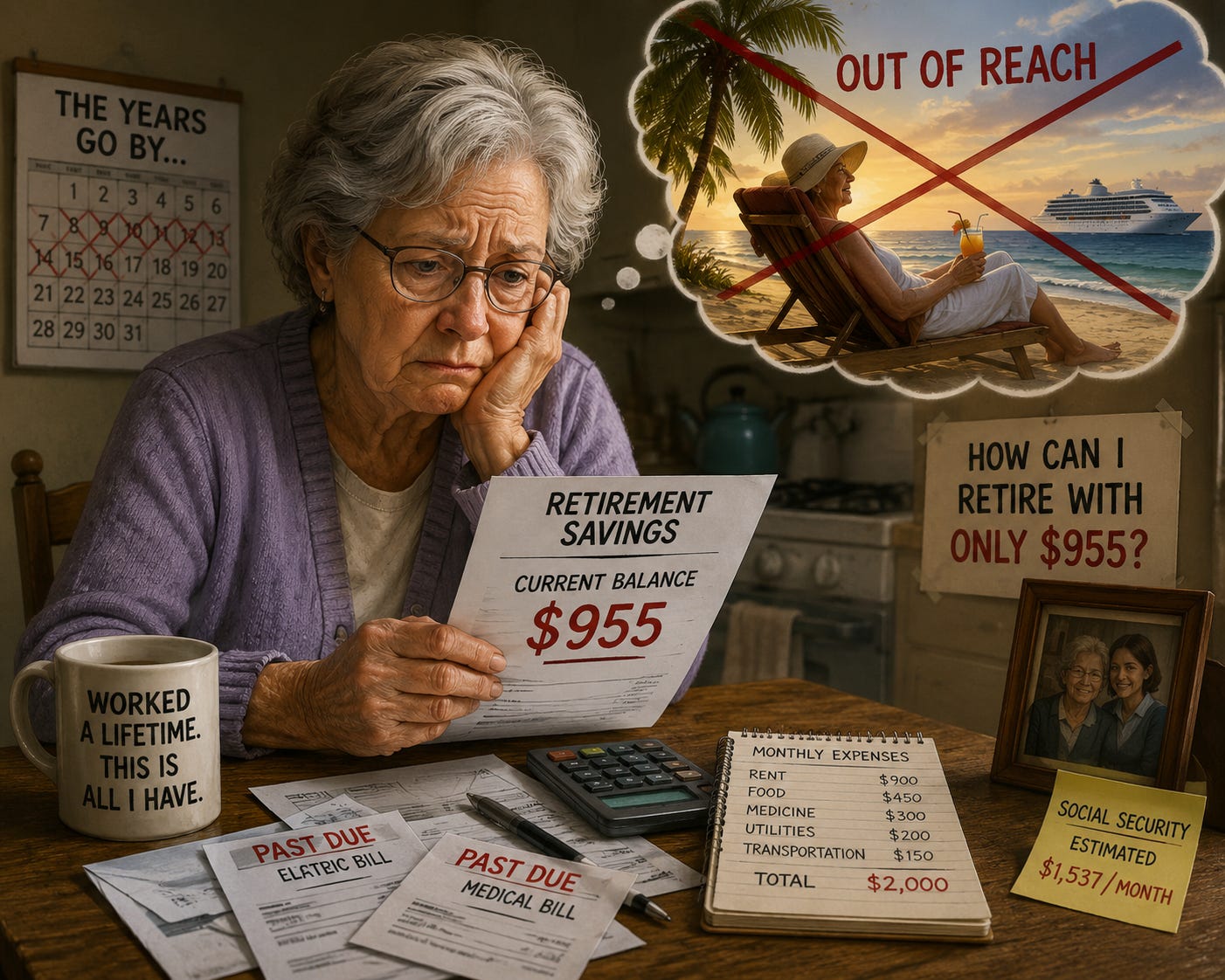
If you include everyone—Americans with no 401(k) or other defined-contribution retirement savings—the median is about $955 for working-age Americans.
A recent (2026) study by the National Institute on Retirement Security (NIRS) found:
Median defined-contribution retirement savings (including workers with $0): $955
Median among workers who have any retirement savings at all: about $40,000
Average including everyone: about $93,000 (pulled upward by relatively few very large accounts)
The difference is striking and illustrates how misleading it can be to cite only the average or median balance among 401(k) participants.
2008 Safety Recall of America’s 401ks
Nearly 20 years ago I wrote in Forbes, “The great 401k experiment of the past 50 years has failed generations of America’s workers.” I asked the question: “What if financial products, like harmful consumer products, were subject to safety recalls?”
To stimulate national debate, I drafted the satirical voluntary recall notice of our nation’s 401ks (below) using a children's toy recall issued by the Consumer Product Safety Commission as my template and sent it out as a press release.
NEWS from Benchmark Financial Services: 401k Recall
FOR IMMEDIATE RELEASE October 9, 2008 Release #01-008
Recall of Most of Nation’s 401k Plans
Benchmark Financial Services, Inc, with anticipated cooperation of the firms referenced below, today announced a voluntary recall of the following consumer products. Consumers should stop using recalled products immediately unless otherwise instructed.
Name of Products: 401k plans; So-called “Retirement” Plans
Units: Trillions in assets
Manufacturers: Financial services firms globally, assisted by employers
Hazard: Consumer will likely incur excessive fees and poor performance resulting in injury to their financial well-being.
Incidents/Injuries: We have received reports from tens of millions of consumers of injury to adults (especially older adults approaching retirement), resulting in anxiety, loss of sleep, housing foreclosures and postponement of retirement plans. Hazardous effects of these plans are generally irreversible in older adults.
Description: This recall involves a financial product marketed to America’s workers (of all ages) which claimed to provide for their “retirement security.” While the product may have some value as a savings vehicle, it will almost certainly not provide for financial security in retirement. Statements that the product will provide retirement security are gross misrepresentations which consumers should disregard. Generally the investment options within the product were sold unaccompanied by the delivery of an owner’s manual (a “prospectus”) that would have disclosed the risks related to these products. Furthermore, even the prospectuses that related to the investment options falsely represented that they were subject to comprehensive federal regulation that would protect the interests of consumers. In fact, the federal agencies that regulate these products (Securities and Exchange Commission and Department of Labor) have been found to be compromised by conflicts of interest. Employers offering the products (401k plans) to their workers generally failed to educate themselves regarding its properties and failed to offer more viable alternatives for their retirement planning.
Sold at: Financial services firms globally; however, predominantly in the United States to American workers.
Manufactured in: Globally by many of the leading financial services firms.
Remedy: Consumers should immediately take the recalled 401k plan products to their employers or the manufacturers of these products for refund.
No recall by any agency of government ensued following the 2008 market meltdown but at least since then it has become more widely acknowledged—largely as a result of hundreds of 401k class action lawsuits—that these savings plans are structurally flawed and have undermined—not enhanced—the retirement security of American workers. Since 2008, the industry had been quietly addressing a few of the most grievous abuses, without drawing attention to the defects inherent in the mass-marketed 401(k) “product.”
Most recently, however, the fees and risks related to 401ks have been ramped-up by permitting toxic cryptocurrency and private equity in plans.
401k Safety Recall 2010/2020
I published the recall again in Forbes in September 2010 and November 2020 and also published an extensive research paper, Secrets of the 401k industry: How Employers and Mutual fund Advisers Prospered as Workers’ Dreams of Retirement Security Evaporated, which documented the unsavory industry practices that played a significant role in creating the defined contribution retirement crisis the nation faces today. The demise of 401ks was no accident and, indeed, was predictable, I wrote.

The demise of 401ks was no accident and, indeed, was predictable decades ago.
My research 16 years ago found that 80% of employers believed 401ks were effective in recruiting employees to come work for them but only 13% of employers believed that the 401k plans they offered would provide retirement security for their workers. In other words, employers understood that offering plans that purported to provide for workers’ retirement security, without obligating employers to pay retirement benefits, was helpful in building their businesses. However, employers privately acknowledged that these plans were not sufficient to provide for workers’ retirement. On the other hand, employers believed that guaranteed retirement income, such as a traditional pension plan, would be far more costly to provide.
Decades ago, employers privately acknowledged that these plans were not sufficient to provide for workers’ retirement.
So, I asked, “Do employers tell their workers there really is no retirement security provided if they stay in their jobs and thereby risk losing employees to competitors? Or do employers maintain the charade that they offer retirement security? Has your employer told you it is virtually inconceivable that the defined contribution plan he offers will provide sufficient retirement income?”
I wrote, “It’s time to stop calling 401ks “retirement” plans and offer workers meaningful alternatives thoughtfully crafted. It’s really not hard to improve retirement plans—provided it’s not left up to Wall Street to propose solutions.”
Calling these workplace mainstays a “retirement plan“ ought to be a crime.
As I concluded:
We are on the precipice of the greatest retirement crisis in the history of the world. In the decade to come, we will witness millions of elderly Americans slipping into poverty. Too frail to work, too poor to retire will become the “new normal” for elderly Americans.
The catastrophic failure of 401k defined contribution plans and the resulting crisis was foreseen and preventable, resulting from inadequate regulatory oversight and unchecked industry greed.
Today, too frail to work, too poor to retire is the “new normal” for elderly Americans.
Please check the links in this wonderful article. They don't all work.
The 955 thing is silly. Can’t believe anyone still falls for this crap