

Over the past decade-plus, CalPERS has been a repeat, large-scale participant in the secondary market for private investments—both as a seller and as a buyer. CalPERS has used neutral terms—such as “mature,” “legacy,” “tail,” “seasoned”—when referring to the problematic funds it sells that are beyond the core value-creation window, often operating under extensions, producing low or slow distributions, and still generating a governance burden (and sometimes a fee/expense drag). Such language is consistent with the private equity industry’s “tail-end” framing, as opposed to the term “Zombie” funds used by the media.
The reasons CalPERS says it engages in secondary sales include:
Liquidity management: turning illiquid fund interests into cash when distributions are weak (especially post-2022).
Portfolio rebalancing/overallocations: when private market Net Asset Values remain “sticky” while public markets move, allocations can drift.
Reducing tail-end drag: exiting older vintages where the rate and consistency at which a fund is returning actual cash to investors over time is low and governance burden is high.
Program redesign: shifting away from historical patterns (e.g., mega-buyout heavy) toward different segments (middle market, growth, venture, emerging managers)—often funded by recycling capital through secondaries.
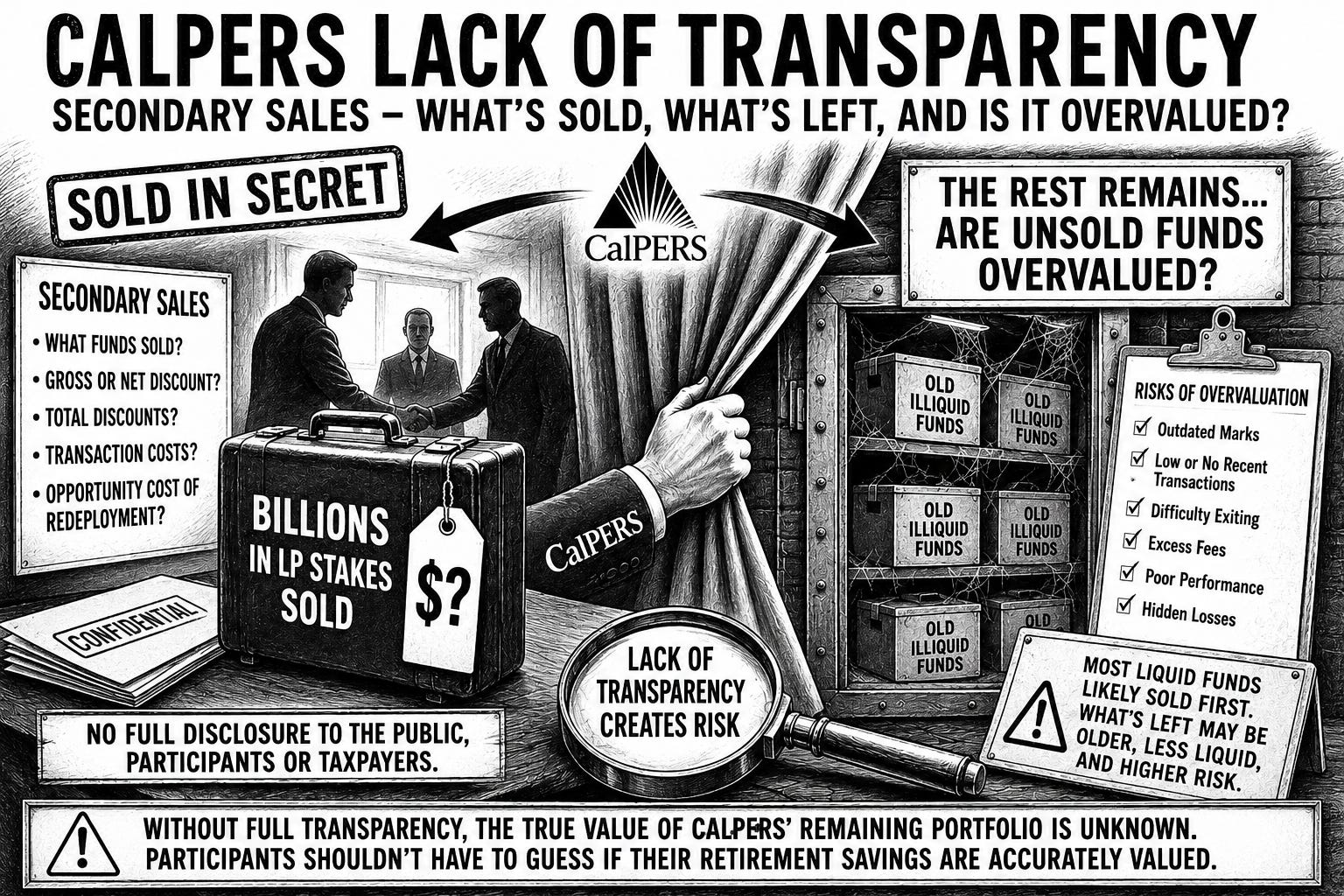
To date, CalPERS secondary sales of private equity interests have profoundly lacked transparency. For the public to evaluate whether its secondary sales have helped or hurt beneficiaries, key facts must be disclosed, such as the exact fund list sold (beyond partial trade reporting), marking policy used at sale, gross versus net discount (including deferred payments/structures), total transaction costs (banker fees, legal, internal), and a clean accounting of the opportunity cost (i.e., where the proceeds were redeployed and how that investment performed).
More disturbing, based upon standard industry practice, we believe the public may reasonably be concerned that the values of certain of the remaining private equity portfolio holdings may be overstated, i.e., not appropriately discounted.
In Limited Partner-led secondary transactions, it is market practice for sellers to prioritize the disposition of fund interests that are most liquid, widely held, and operationally transferable, as these assets attract the broadest buyer interest and command the highest prices. Accordingly, it is reasonable to infer that large-scale secondary sales by CalPERS would initially consist of its more liquid private equity holdings, with less liquid, older, or more complex fund interests, requiring potentially far greater discounts, remaining in the portfolio. As the nation’s largest public pension, its secondary sales are scrutinized by its board, media, and stakeholders. Large reported discounts create reputational and political risk.
It is reasonable to infer that large-scale secondary sales by CalPERS would initially consist of its more liquid private equity holdings, with less liquid, older, or more complex fund interests, requiring potentially far greater discounts, remaining in the portfolio.
• History of CalPERS Secondary Sales
In 2012, the pension reportedly sold about $1.5 billion in private equity stakes—which was one of the larger secondaries at the time. No detailed public list or discount was disclosed.
In 2013, CalPERS decided to sell its management-company stake in Carlyle via the group’s secondary offering. CalPERS framed this as a disposition through the offering, not the sale of a limited partnership interest.
In November, 2015, the pension reportedly sold $1 billion of private equity fund stakes to more than 10 buyers, but did not publicly disclose any discount, fund list, or transaction costs.
In October 2015, Blackstone announced it would acquire $3 billion of secondary global real estate interests from CalPERS (described by Blackstone as largest real estate secondary at the time). The pricing and discount was not disclosed by CalPERS.
In June 2018, CalPERS Investment Committee transcript referenced “liquidating nearly $3 billion with the commingled funds secondary sale” and “legacy asset sale.” No discount was disclosed.
In 2022, CalPERS hired Jefferies to run a multi-billion-dollar private equity portfolio sale. Multiple outlets reported that the $6 billion Limited Partner-stakes sale was priced at about a 10 percent discount to the portfolio’s September 2021 value. CalPERS did not publish a full fund list, or all transaction costs. Even when the overall discount is widely reported, the public still cannot fully quantify the economic impact without full deal terms and underlying portfolio composition.
Said Bloomberg:
The deal is not only the largest of its kind by Calpers, but private equity executives said it’s probably the biggest-ever involving second-hand fund stakes changing hands.
Trading in such size came at a price: Calpers sold its holdings at a roughly 10% discount to their value in September 2021, some of the people said. The fund softened the blow thanks in part to how it structured the deal, they said.
In 2024-2025, CalPERS continued test pricing for additional limited partner-led sales. In January 2025, CalPERS reportedly sold another $3-4 billion of legacy stakes to a consortium of investors led by Ardian, AlpInvest and Partners Group. CalPERS did not disclose the pricing or discount. Thus, contemporary market averages (88-90 percent of Net Asset Value) may be a reasonable yardstick for what similar large limited partner portfolios were selling for at that time.
As of July 2025, Jefferies noted:
Global secondary market volume… increased 51%... from H1 2024. This represents the largest year-over-year H1 volume increase and the most active 6-month period in market history… LPs increasingly turned to the secondary market to generate liquidity, rebalance portfolios and manage overallocations, particularly as traditional exit channels remained subdued (emphasis added). Average pricing for all LP portfolios was 90% of NAV (emphasis added).
For 2025, additional sales were reported as being marketed or shopped.
• Independent IG Can Improve CalPERS Secondary Sale Transparency and Reduce Overvaluation Risk
An independent IG can materially reduce valuation risk, selection bias, and hidden costs in private-investment secondary sales by changing what is disclosed, when it’s disclosed, and who validates it. The goal is to ensure the public can tell whether secondary sales helped or hurt beneficiaries, and whether remaining marks are credible.
Secondary sales are uniquely risky (and opaque) in that they combine three hazards that don’t exist in ordinary reporting of asset sales. Selection bias is a primary concern since sellers typically offload the most liquid, transferable interests first, leaving the least liquid, most problematic assets behind. Also, while prices reveal market reality for what has been sold, remaining holdings may stay on inflated manager marks. Finally, headline discounts related to sales often mask deferred consideration, earn-outs, stapled commitments, and transaction costs that materially change (increase) the “true” discount. Absent independent oversight, these dynamics can overstate remaining portfolio value, distort performance, and shift risk to beneficiaries without their knowledge.
Pre-sale transparency efforts by the IG focus upon making the decision auditable before execution. Typically, boards and the public see a single headline about a sale with no way to judge quality or bias. The IG would require a complete list of funds proposed for sale; a selection rationale memo explaining why these particular funds were selected; and confirmation that selection was not driven solely by ease of sale or reputational optics. Also, a pre-sale mark policy disclosure should include who marks the assets, when they were last marked and any recent changes to valuation methodology. This creates a baseline that allows later testing of whether CalPERS systematically sold its best assets first.
Since reported discounts on secondary sales often ignore deferred payments, fee leakage, and deal structure, in order to ensure sale-price integrity the IG can require gross versus net discount reconciliation; full transaction-cost accounting; and buyer universe disclosure, including number of bidders, strategic versus financial buyers and any conflicts. Without this, a so-called 10 percent discount might really be far greater, say, 20–30 percent after costs and structure.
Post-sale valuation testing of the remaining portfolio is critical. If CalPERS sells its most liquid interests first, remaining holdings are, by definition, less liquid and likely worth less than their marks. A mandatory post-sale review by the IG should compare sold-fund discounts to similar unsold funds and apply implied market discounts to remaining holdings, as well as quantify the valuation gap. A forced-liquidation scenario analysis should determine the discount that would be required to sell the next 10, 20 and 30 percent of remaining value. Mark-to-market challenge memorandum should identify funds whose marks are no longer credible given observed transaction prices. This is how the pension prevents “selling price discovery” from coexisting with unchanged—and inflated—marks elsewhere in the portfolio.
If CalPERS sells its most liquid interests first, remaining holdings are, by definition, less liquid and likely worth less than their marks.
Secondary activity increasingly involves General Partner-led transactions. General Partner-led deals are where valuation risk and conflicts are most acute—and least visible. As a result, IG review in these situations should focus upon conflicts of interest, fairness-opinions and analysis of comparative alternatives to the General Partner-led sale. Upon completion of the sale, IG review should include use of proceeds disclosure and performance of the redeployed capital. A secondary sale that supposedly reduces risk but underperforms the sold assets is not neutral—it’s value-destructive.
Internal reviews lack credibility when reputational risk is high. An independent IG with authority to commission independent secondary-sale audits and ability to publish public IG findings without staff veto, as well as a standing secondary-transactions report covering fund-level details, net economics, residual valuation impacts and lessons learned can improve transparency, performance, public confidence, as well as reduce risk.
Secondary sales are not just liquidity events—they are valuation truth-serum events. An independent IG makes that truth visible by forcing fund-by-fund disclosure, requiring net-economic transparency, testing remaining marks against market reality, and holding decision-makers accountable for both what was sold and what was left behind.
Without that IG oversight, secondary programs risk becoming a way to sell the easiest assets, preserve optimistic marks elsewhere, and quietly shift long-term valuation risk onto beneficiaries—exactly the outcome an IG is designed to prevent.
Marking to market would hurt bonuses https://commonsense401kproject.com/2026/05/22/calpers-sets-its-own-excessive-pay-off-the-charts/